

Publication date: 13 October 2026
The Cognitive Layer in Physical AI: How Machines Turn Perception into Decisions
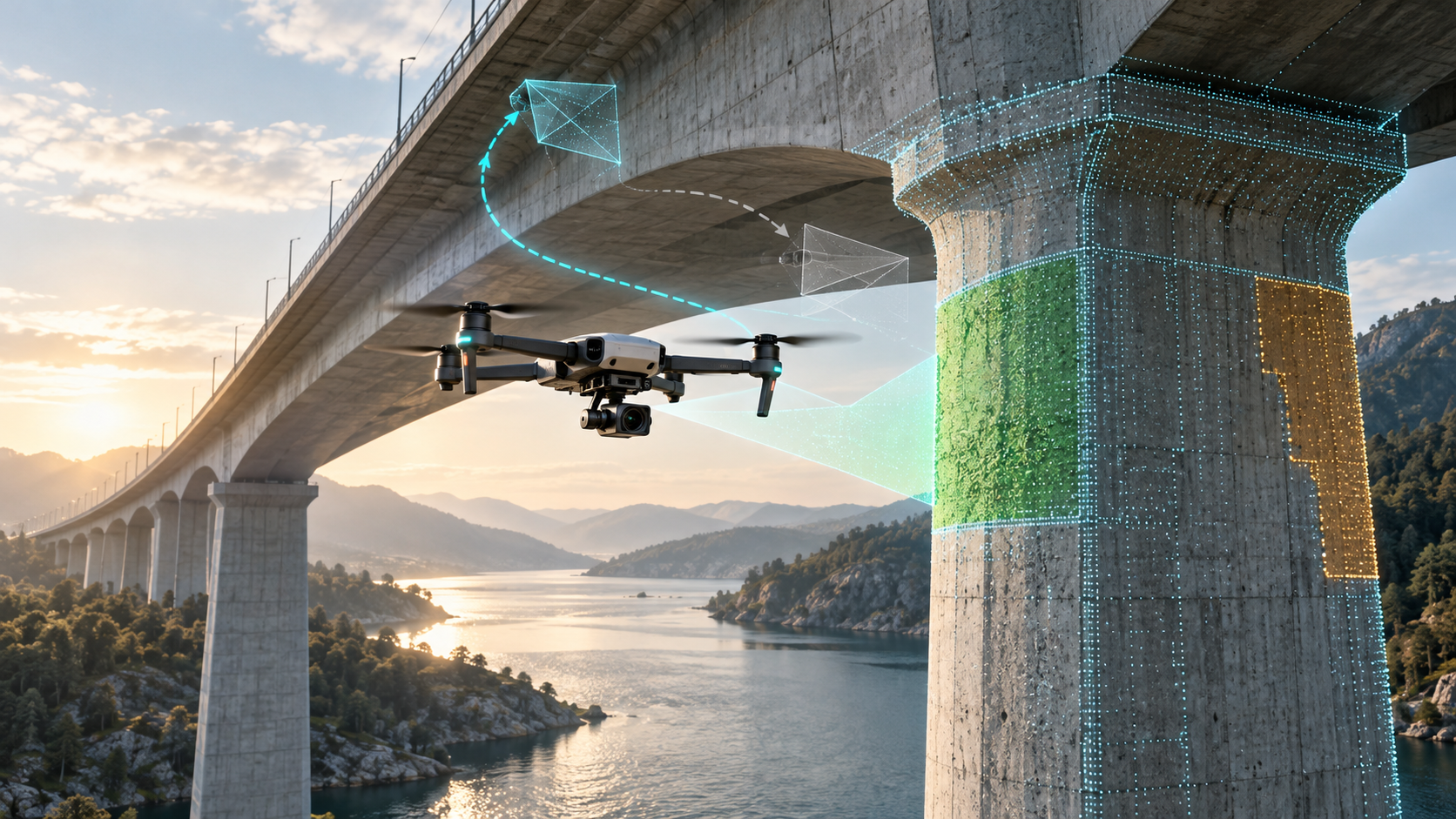
Imagine a drone inspecting a bridge. It approaches a support column, positions its camera, captures images, and moves toward the next inspection point. Behind this activity, hardware and software work together to sense the environment, process information, plan movements, and control the motors. Completing the inspection also requires task-level decisions: which surface should be examined next, whether the current view is useful, and whether the requested area has been covered. These questions bring us to the cognitive layer in Physical AI.
Behind Every Intelligent Action Is a Stack
A machine performing a physical task relies on several cooperating capabilities. Sensors collect information, software estimates its position, perception identifies relevant objects, and controllers coordinate movement.
But executing movements is only part of completing a task. The system also needs to relate its observations to an objective and determine what should happen next.
For a bridge-inspection drone, reaching a support column does not establish that the inspection is complete. The system needs evidence that the requested surfaces have been photographed adequately.
To understand how cognitive capabilities support these decisions, we first need to understand the technology foundations beneath them.
The Foundations of Physical AI
Physical AI depends on a technology stack: cooperating hardware and software components that make sensing, computation, communication, and movement possible. This overview adapts the bottom-up explanation in the reference video, The Only Physical AI Guide You Need for 2026.
Computing hardware supplies processing power for software, sensor data, and AI models. Depending on the application, this can include processors, graphics processors, and specialized computing devices.
The operating system and drivers manage computing resources and provide access to connected devices, including cameras and other sensors.
Application code implements behavior and connects the system's functions. It coordinates how information is processed and how actions are requested.
AI frameworks and models provide tools and learned capabilities for processing observations, interpreting instructions, and selecting actions.
Runtime and deployment tools support efficient model execution and compatible software environments. They help developers package and operate the components together.
Computer vision extracts useful information from images and video, such as object locations, movement, and scene structure.
Robotics middleware enables communication between sensors, software components, and robot interfaces. For example, it can connect a camera-processing component with a planning component and a motor-control interface.
These components form a practical map rather than a universal architecture. They can overlap, and their arrangement depends on the machine. ROS 2 is robotics middleware, while Linux is a common operating-system choice.
The technology stack explains how the system operates. To locate cognition within it, we need to examine what the system does.
From Infrastructure to Intelligence
A functional view of Physical AI follows a continuing loop: Perceive → Reason and decide → Act → Observe the result.
Perception provides information about the situation. Reasoning connects that information with a goal. Action changes the physical world, and subsequent observations reveal the result.
Vision-language-action models, or VLAs, provide one approach to connecting these functions. They combine visual observations, language input, and action outputs.
Other architectures distribute responsibilities across separate perception models, planners, and controllers. Research also explores embodied-reasoning models connected to existing lower-level control systems.
The cognitive layer is a useful name for goal interpretation, contextual reasoning, task planning, and progress assessment within these systems. It is an explanatory framework, rather than a requirement that every machine contain a separate component with that label.
What Is the Cognitive Layer?
The cognitive layer connects what a machine observes with what it is trying to achieve, helping determine the next task-level action.
Consider the bridge-inspection drone. Perception might identify a support column and estimate its position. The inspection goal specifies which surfaces need to be photographed.
Cognitive capabilities help relate the two: the front surface has been covered, the side remains unexamined, and another viewpoint is needed.
Motion planning then determines a feasible route to that viewpoint, while control coordinates the movement.
Perception answers: what is present, and what is happening? Cognition asks: given the goal and context, what should happen next? Planning and control address: how can the machine carry out that action?
These boundaries are not always sharp. A learned model may handle several responsibilities together.
Here, cognitive refers to capabilities such as reasoning and planning. It does not imply consciousness, human intentions, or human-like experience.

What Does the Cognitive Layer Do?
Embodied-reasoning research includes capabilities such as spatial understanding, task planning, and progress estimation. These provide a useful basis for explaining cognition in Physical AI.
The following bridge-inspection scenario is illustrative. It describes how a suitably designed system could combine these functions.
Interpret the goal: An instruction such as inspect this bridge support needs an operational meaning. The system needs to know which support is intended, which surfaces matter, and what evidence counts as completing the inspection. Requirements may come from an operator, a predefined procedure, or a structured task description.
A goal becomes useful when it connects to observable outcomes.
Use context and relationships: The drone needs more than a list of detected objects. It needs information about how surfaces relate to one another, which viewpoints provide access, and which parts of the inspection remain unfinished.
Context makes observations relevant to the task. A beam's location matters differently when the goal is photographing it than when the goal is navigating past it.
Break the task into steps: The system could organize the inspection into a sequence of approaching the support, capturing the first surface, moving to another viewpoint, photographing the next surface, and checking coverage.
This is task planning: identifying the activities needed to achieve the goal. Motion planning addresses which paths and movements can carry out each selected activity.
Evaluate possible actions: Several viewpoints might provide an image of the same surface. A decision process could compare them using available space, visibility, and inspection requirements, then select an action suited to the situation.
Assess progress and revise the plan: After taking a photograph, the drone needs evidence that the intended surface was captured adequately. If the view was obstructed, another image may be required. If the surface is covered, the next task can begin.
This closes the task-level loop: results inform subsequent decisions.
Following One Task Through Every Layer
Imagine that the drone must photograph the underside and side of a bridge support.
Computing hardware runs the software. The operating system and drivers provide access to sensors and devices. Application code and middleware exchange information between components. Models and algorithms process observations and support decisions.
At the functional level, sensing captures images and position-related measurements.
Perception and state estimation locate the support and estimate the drone's position relative to it.
Cognition and task planning select the next surface to inspect and the desired viewpoint.
Motion planning and control determine and execute a feasible movement toward that viewpoint.
Feedback provides information about the new position and the image collected.
Suppose the drone reaches its viewpoint but the target is partly obscured. A task-level decision could request a different view. The motion planner determines how to reach it, while the controller maintains stable flight.
This example shows how the technology stack supports functional capabilities and how cognition connects those capabilities with the inspection objective.
Cognition in Practice: Cameras, Drones, and Robots
The cognitive layer looks different across applications. The following company-neutral scenarios illustrate its possible role.
Intelligent cameras: Consider a camera observing a warehouse crossing. Perception detects a worker and a mobile robot, tracks their movement, and estimates their positions. A decision process relates that activity to the crossing's rules and the robot's current operation.
In a suitably designed system, the response could be to ask the robot to pause while the worker crosses. The distinction is between identifying objects and interpreting their relationship in a task-relevant situation.
Understanding behavior means assessing observable activity and context. It does not mean knowing what a person is thinking.
The physical response depends on integration. The camera-based system must communicate with equipment capable of performing the action.
Autonomous drones: A drone's cognitive capabilities can help organize an inspection around the requested evidence. A system could track which surfaces have been photographed and choose the next inspection target.
If an image does not satisfy the task's criteria, the system could request another viewpoint. This differs from maintaining flight stability or making a rapid obstacle-avoidance adjustment, which can operate through dedicated planning and control components.
The cognitive contribution concerns the mission: what to inspect next and whether the requested work is complete.
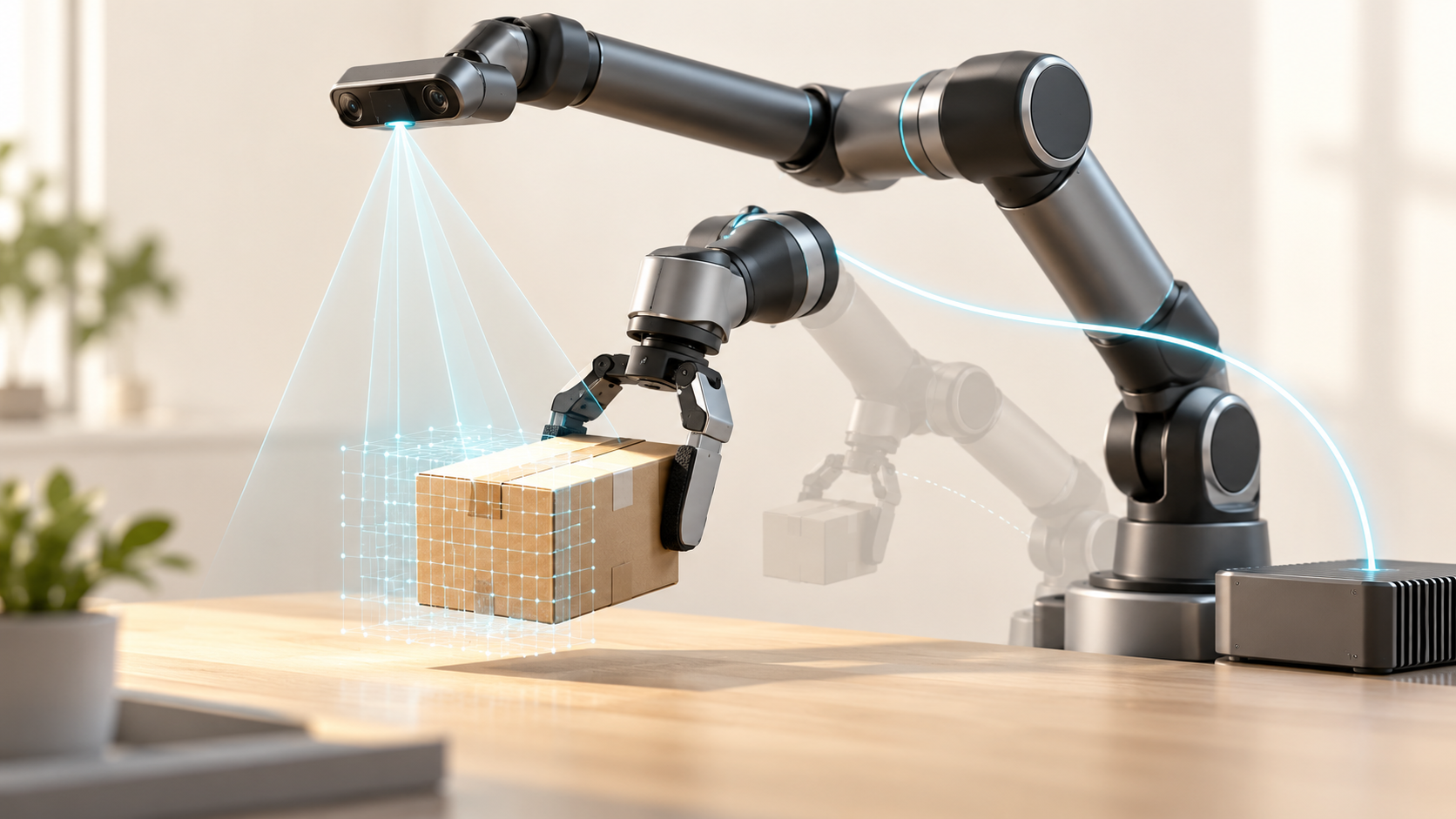
Manipulation robots: Imagine a robot packing several objects into a container. Perception identifies the objects and available space. Task planning could select an order that places a larger item first, then arranges smaller items around it.
The robot's manipulation skills carry out each grasp and placement. Observations of the resulting arrangement inform the next step.
These examples illustrate how task decisions and physical skills cooperate. The exact capabilities depend on the system's training, equipment, and software.
How Cognition Connects with Action and Feedback
Physical activity involves decisions at different timescales. A drone's controller continually coordinates flight. A manipulation controller adjusts movement during a grasp. Task-level planning chooses an inspection target or the next object to pack.
Not every motor adjustment needs a new high-level decision. Lower-level components can execute a selected action and report relevant results.
Feedback becomes useful at the task level when it affects the plan. An object placed in an unexpected position may require a revised packing sequence. An unsuccessful grasp may require another attempt.
Robotics research demonstrates systems that respond to changes in objects or instructions and revise their actions. It also describes connecting reasoning capabilities with existing controllers.
The cognitive layer participates in an ongoing cycle: Interpret the situation → Select a task step → Execute → Evaluate the result → Update the plan.
How Learning Supports Cognitive Capabilities
Learning can provide both broader capabilities and task-specific behavior.
Training on varied data can support recognition, language interpretation, and relationships between observations and actions. Demonstrations provide examples of tasks being performed. Reinforcement learning improves behavior through feedback about outcomes.
Simulation supplies environments in which selected skills can be trained and evaluated. Varying conditions, such as object positions or lighting, can broaden the situations encountered during training.
Real-world observations can inform further development and evaluation. This relationship between models, simulation, reinforcement learning, and real-world feedback is explained in the reference video, What is Physical AI? How Robots Learn & Adapt in Real Life.
These methods serve different purposes. Training a precise grasp and training a model to interpret a request are related parts of a system, but they are not the same capability.
Operating with a trained model does not necessarily mean the machine continually updates that model while working. Adaptation during a task can involve changing a plan using new observations.
Connecting the Stack to the Goal
Return to the drone inspecting the bridge.
Its hardware and software make computation, sensing, communication, and movement possible. Perception describes the relevant scene. Planning and control produce feasible movements.
Cognitive capabilities connect these resources with the inspection goal: selecting a target, considering the situation, evaluating progress, and choosing the next task step.
The cognitive layer helps a Physical AI system use what it observes to decide how to pursue an objective and use the results to guide what happens next.
References
Physical AI technology stack guide: https://www.youtube.com/watch?v=x35bs2XFi0w
Physical AI learning and simulation explainer: https://www.youtube.com/watch?v=GOsnf5lOIrI
Research on embodied reasoning and robotic action: https://deepmind.google/blog/gemini-robotics-brings-ai-into-the-physical-world/
Embodied reasoning, task planning, and progress estimation research: https://arxiv.org/abs/2510.03342