

Mohamed Hatem
Publication date: 1 October 2026
What Is Physical AI?
Ask an AI chatbot how to fold a shirt, and it can describe the process. Give the same task to a robot, and those instructions become a physical problem. The robot must locate the sleeves, identify overlapping fabric, choose where to grasp, and observe how the shirt changes after each movement. Physical AI connects these observations with decisions and coordinated actions. It brings machine intelligence into systems that manipulate objects, navigate spaces, and respond to events in the physical world.
From Answering Questions to Taking Action
Most people encounter AI through digital outputs: an answer, an image, a recommendation, or a software action. Physical AI extends that interaction into machines that move and influence their surroundings.
Consider folding a shirt. A written explanation can describe a sequence of steps, but a robot needs to determine how those steps apply to the shirt in front of it. Where are the sleeves? Which parts overlap? What happens when one corner is lifted?
Each movement changes the situation. Once the robot pulls a sleeve, the fabric takes a new shape. The next action must account for that change.
Researchers have demonstrated robots folding laundry, assembling cardboard boxes, and opening bags. These experiments show particular manipulation capabilities; they do not establish that a machine can already perform every household task.
The same relationship between perception, decisions, and movement appears in warehouses, autonomous vehicles, intelligent camera systems, and drones.
What Is Physical AI?
Physical AI refers to AI systems that enable machines to perceive their environment, make decisions, and perform physical actions. It brings together capabilities from machine learning, computer vision, robotics, and control engineering.
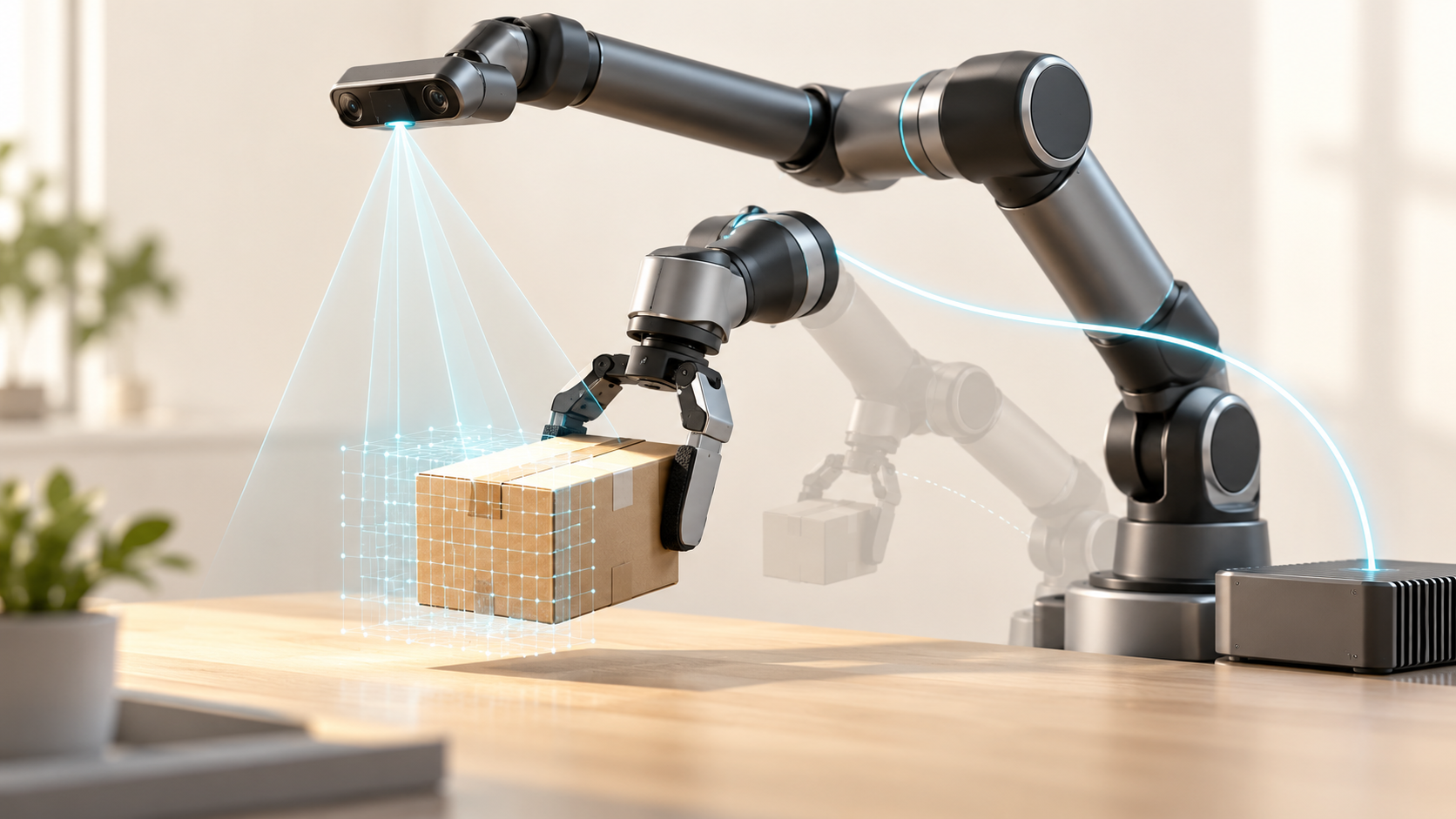
A system might use cameras to locate an object, a learned model to choose a grasp, and motors to move a robotic arm. Sensors then provide information about whether the action is working.
Intelligence operates through a physical body. A wheeled robot can travel across a floor, a robotic arm can manipulate objects within its reach, and a drone can move through three-dimensional space. The AI must choose actions that suit the machine's physical capabilities.
Actions change the environment. Pushing an object changes its position, lifting fabric changes its shape, and turning a drone changes what its cameras observe. Physical AI therefore involves a continuing relationship between observation and action.
Useful perception supports a task. Recognizing a cup is one capability; estimating where to grasp it and how to lift it is another. The information a machine needs depends on the goal it is trying to achieve.
Physical AI does not require a human-shaped robot. A stationary arm, a mobile platform, or an autonomous vehicle can all connect AI capabilities with physical activity.
How Is Physical AI Different from Other AI?
Consider the instruction: prepare this parcel for shipping. A generative AI assistant could explain the packing procedure or draft a shipping note. A software AI agent could retrieve the order, generate a label, and update the shipment record. A Physical AI system could handle the item, place it in a container, or move the parcel.
These capabilities can work together. A digital agent might manage the order while a robot performs the physical handling.
Generative AI can also form part of a Physical AI system. One approach uses a vision-language-action model, or VLA, to connect visual observations and language instructions with robotic actions.
Vision provides information about the scene, language communicates the task, and action represents the movements needed to carry it out. For example, a suitably trained system could use an instruction and camera observations to guide a robot placing an object into a container.
Physical AI overlaps with conventional automation. Industrial robots have long used sensors, feedback, and motion planning. Learned capabilities can extend these systems by helping them interpret varied scenes or choose actions across a wider range of examples.
The distinction depends on capabilities. A machine's appearance does not establish its intelligence: a stationary arm can perform advanced manipulation, while a humanoid may follow a tightly scripted routine.
How Does Physical AI Work?
A useful conceptual model is: Sense → Interpret → Plan → Act → Receive feedback. Different systems organize these functions differently. Some use separate components, while others combine several functions within a learned model.
Sense: Gather information. Consider a robot retrieving an item from a crowded storage compartment. Cameras provide images, depth sensing helps estimate the arrangement of objects, and force sensors measure contact during handling. These inputs offer complementary information about the scene and the robot's interaction with it.
Interpret: Identify the relevant situation. The system identifies the requested item, estimates its position, and determines which surfaces are accessible. It may distinguish the target from surrounding objects and estimate the space available for extraction.
Plan: Choose an approach. The robot selects a suitable contact point and movement. It might choose a surface for a suction tool and plan how to withdraw the item. That choice depends on both the target and the surrounding arrangement.
Act: Execute the movement. Motors move the arm and operate its tool. Control systems coordinate the motion required to approach, grasp, and retrieve the item.
Receive feedback: Check the result. During extraction, the system continues observing. It can monitor suction pressure, changes in the scene, and contact forces. Documented manipulation systems use this feedback to evaluate a hold, respond to contact, or attempt another picking point.
This is closed-loop control: observations of an action's result influence what happens next. Imagine reaching into a crowded drawer. You look, touch, adjust your hand, and continue. A machine using feedback follows a comparable pattern of observation and adjustment.
How Do Machines Learn to Operate in the Real World?
Physical AI development can combine several learning methods. Each supplies a different kind of experience, from examples of successful behavior to feedback about outcomes.
Learning from demonstrations: A person operates a robot remotely or guides it through a task. The recorded examples connect observations with actions. An imitation-learning system uses these demonstrations to learn a policy: a model for choosing actions from available information.
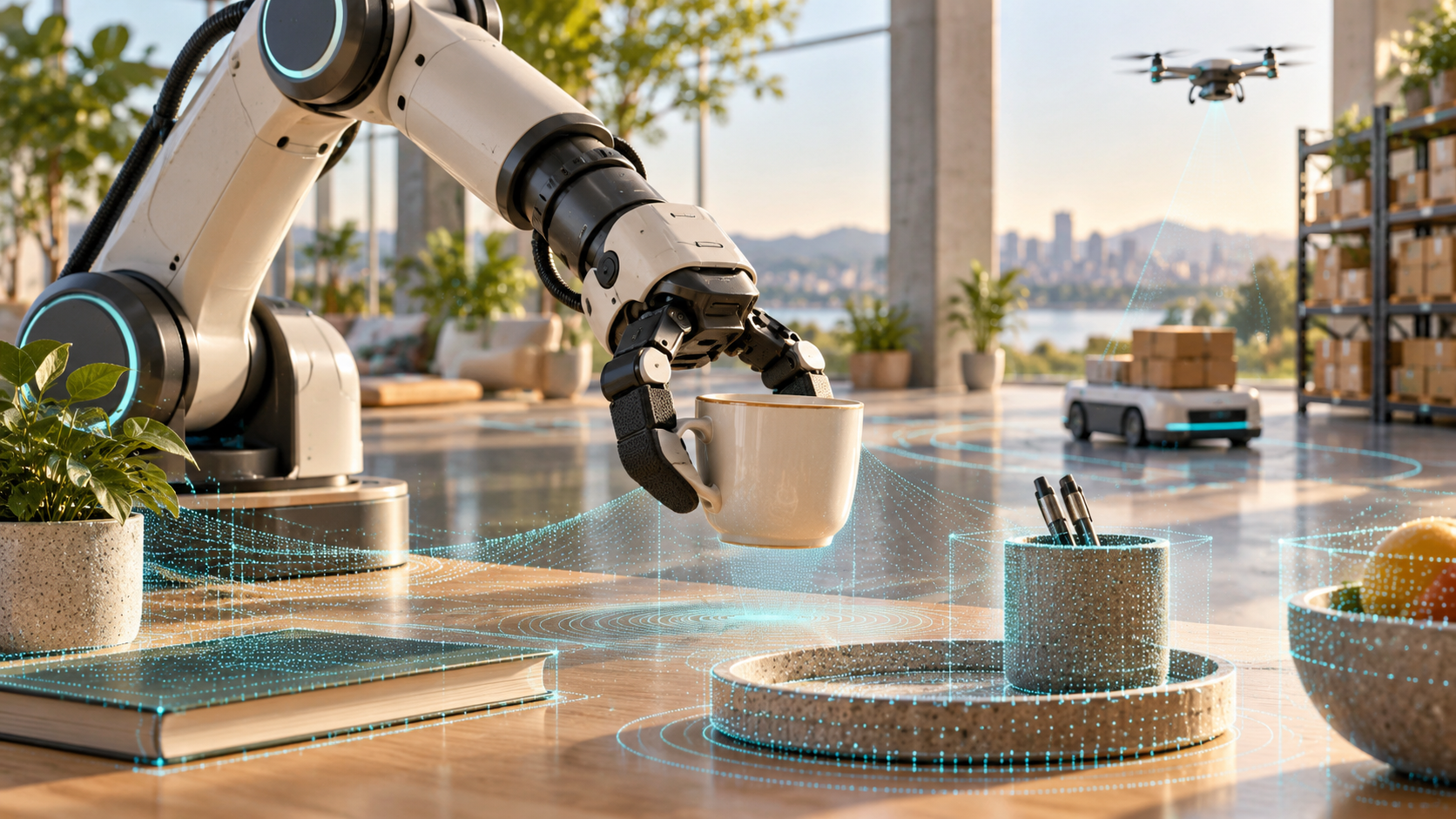
For an illustrative cup-handling task, demonstrations might include cups in different positions and orientations. Training aims to produce behavior that remains useful across those variations.
Learning through rewards: In reinforcement learning, a system improves its policy using feedback about outcomes. A simulated robot might receive a reward for placing an object at a target location. Repeated attempts allow training to favor actions that achieve the objective.
Demonstrations provide examples to learn from; rewards provide criteria for evaluating behavior. Some robotics workflows combine both.
Practicing in simulation: A virtual environment can contain modeled robots, objects, sensors, and physical interactions. Developers can vary conditions during training through a technique called domain randomization.
For example, a virtual object might appear in different locations, under different lighting, or with different physical properties. The purpose is to reduce dependence on one exact setup. Developers then evaluate the trained policy on physical hardware to assess how well its behavior transfers.
Reusing skills across tasks: Researchers are developing models trained across multiple tasks and robotic platforms. These models can be adapted to particular activities, allowing new training to build on previously learned capabilities.
Training and operation remain distinct. A robot using a trained model is not necessarily updating that model continuously while it works.
Where Is Physical AI Used?
Physical AI appears in machines that move, manipulate objects, or connect observations with physical responses. The following examples include established capabilities and illustrative scenarios showing how they can be applied.
Warehouse navigation and handling: Autonomous mobile robots transport goods through facilities, using sensors to detect objects and guide navigation. Robotic manipulation systems identify and handle individual products. Both capabilities are used in warehouse operations.
Consider a robot carrying a cart toward a workstation. It needs both a destination and information about the space it travels through. As the scene changes, its navigation system uses new observations to guide movement. Handling an individual product requires additional skills, including identifying the target, selecting a grasp, and controlling contact.
Intelligent cameras: An AI-powered camera system can analyze activity over time, track movement, and identify patterns that call for a response. Understanding behavior here means interpreting observable activity and context, rather than knowing a person's intentions.
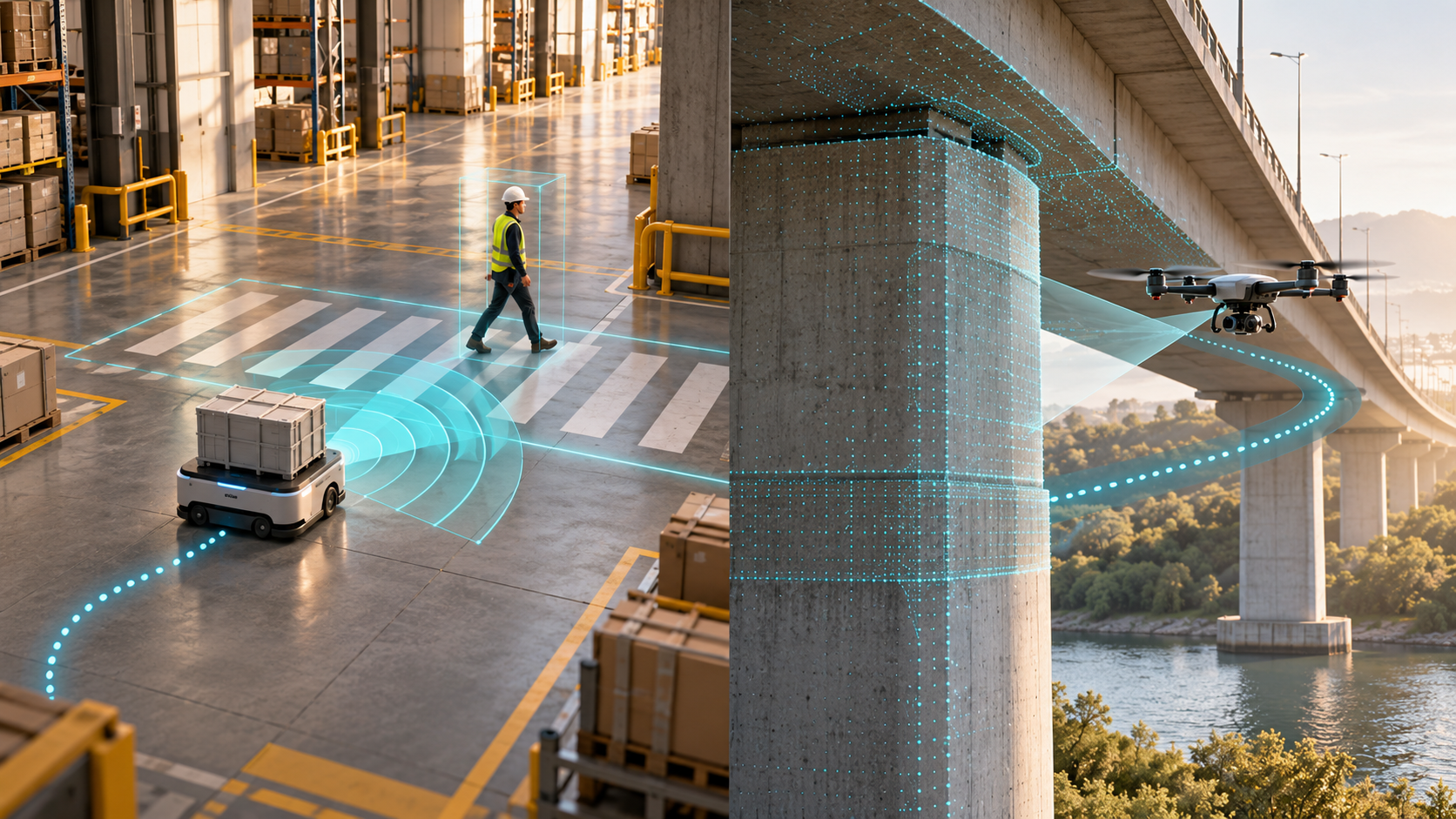
Consider an illustrative warehouse crossing. A worker and a mobile robot approach from different directions. A suitably designed camera system tracks their movement, identifies a potential conflict, and signals the robot's controller to slow down or stop.
The sequence becomes: Observe movement → Interpret the situation → Select a response → Trigger physical action. Another application connects visual inspection with a mechanism that removes defective items from a conveyor.
The camera supplies observations, AI interprets them, and a connected machine performs the response. A system that only generates an alert provides intelligent monitoring. Linking its decisions to physical equipment completes the perception-to-action loop.
Autonomous drones: A drone can use cameras and other sensors to estimate its position, map nearby space, detect obstacles, and select movements that support a task.
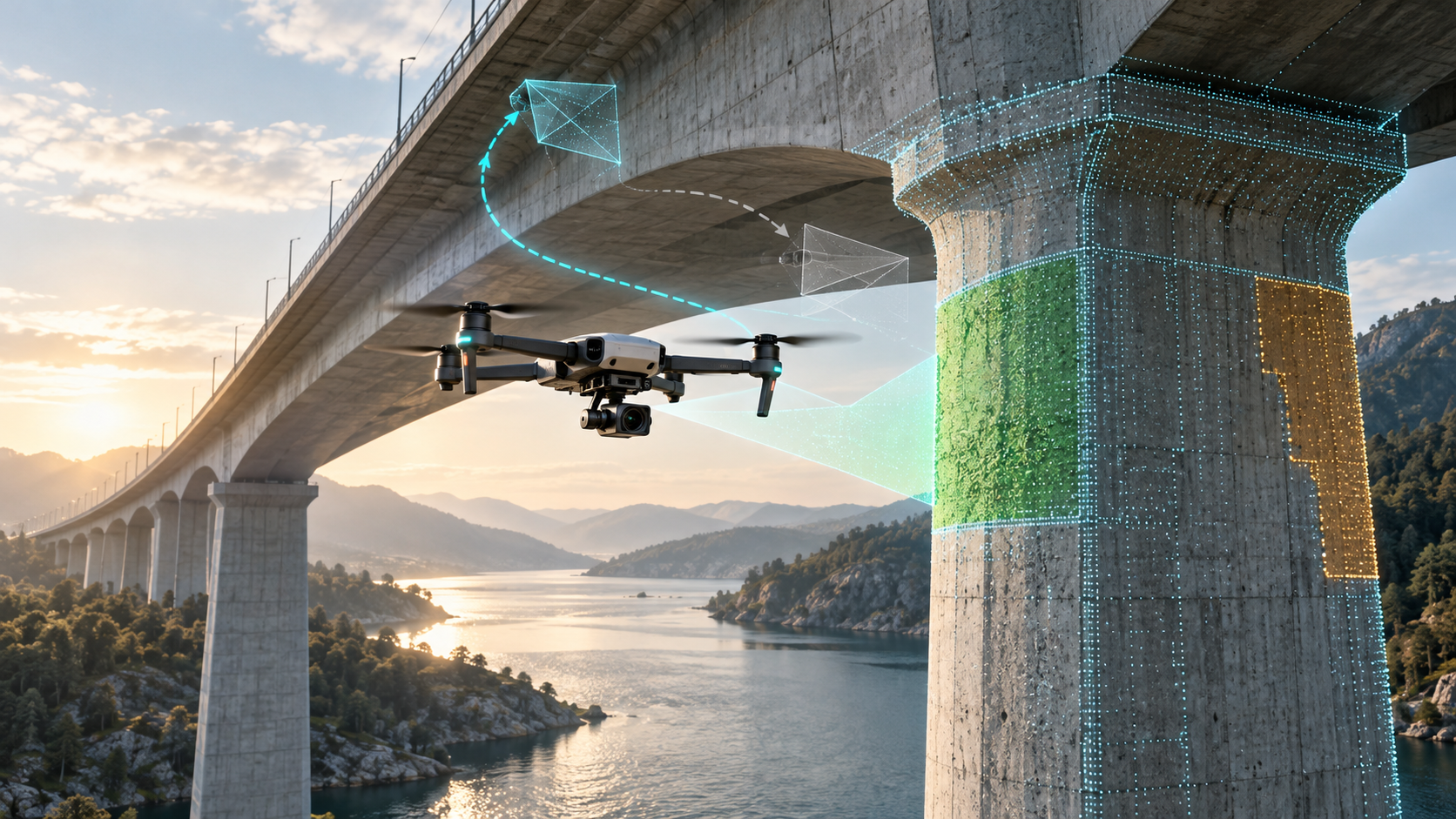
Consider a drone inspecting a bridge. Its goal is to collect images of selected surfaces. An appropriately equipped system can identify available flight space, plan an approach, and position itself for useful views.
As the drone moves, its observations change. A support beam may obstruct a route, or another viewpoint may be needed. The system updates its spatial representation and adjusts its flight.
Environmental reasoning involves practical questions: Where is there room to move? Which route reaches the target? What position provides a useful image? The loop becomes: Observe surroundings → Build a spatial model → Plan a route → Adjust flight → Observe again.
A related drone capability is following a selected moving subject while accounting for detected obstacles. The available autonomy depends on the equipment and operating mode.
Autonomous vehicles: Autonomous driving connects sensor information with decisions about steering, braking, and acceleration. Systems interpret their surroundings, anticipate movement, and select driving responses.
Consider a pedestrian near a crossing. Recognizing the person is one part of the task. The vehicle also needs to determine how its movement should relate to the person's possible movement. This connects perception, prediction, and physical control.
Everyday object manipulation: Laundry folding, opening bags, and packing containers are useful research tasks because objects can change position and shape during handling. Demonstrations provide evidence of particular capabilities and help researchers study how observations and instructions translate into movement.
What Comes Next for Physical AI?
The research and applications above suggest three directions: broader reuse of skills, more natural instructions, and richer feedback.
Broader reuse of skills: Models trained across tasks and robot types could make it easier to adapt learned capabilities to new applications.
More natural instructions: Systems connecting language, vision, and action could help people communicate goals in everyday terms, while the machine determines suitable physical movements.
Richer feedback: Combining visual observations with contact and other sensor information could support more capable physical interaction.
These directions reinforce one another. A useful machine needs to interpret the goal, select appropriate actions, and adjust its behavior as the task unfolds.
Return to the shirt at the beginning of this article. Folding it requires the robot to locate useful grasp points, move the fabric, observe its new shape, and select another action.
Physical AI brings these capabilities together. It enables machines to turn goals into coordinated physical behavior, whether that means retrieving a product, responding to activity seen by a camera, navigating around a bridge, or folding a shirt.